Working with Async code
Important
This chapter covers caveats when spawning a future as a thread using the
spawn_asyncAPI in this library. It is not a tutorial for async Rust. Basic understanding of async Rust is required.
Caution
Async code also requires extreme caution when dealing with panics and unhandled rejection!
Please refer to Async Panics after reading the sections below
When an async thread is required
If we only look at the Rust code, it’s hard to imagine why the thread needs to be async. After all, the standard library does not have a method to spawn a future as a thread:
#![allow(unused)]
fn main() {
// spawn a thread
let thread = std::thread::spawn(move || {
    // code here executes in a separate OS thread
    // while sharing memory with other threads in the same process

    // Want async? use an async runtime such as tokio!
    tokio::runtime::LocalRuntime::new()
        .unwrap().block_on(async move {
            /* async rust code */
        });

    // when the thread is done, it's done for good - the OS
    // may reclaim (destroy) the resources of this thread
});
}
However, if we zoom out to include the JS side, we will see some problems
with synchronous threads. Let’s brainstorm this together: to make the code less verbose, suppose we import
this function from the JS side with wasm_bindgen:
async function fetch_text(url) {
    const response = await fetch(url);
    const text = await response.text();
    return text;
}
#![allow(unused)]
fn main() {

#[wasm_bindgen]
extern "C" {
    fn fetch_text(url: &str) -> Promise;
}

let thread = wasm_bindgen_spawn::spawn(move || {
    // code here executes in a separate worker context
    // while sharing memory with other threads in the same process

    // What if we need to wait for some async JS API?
    fetch_text("https://github.com");
    // what now?

    // when the thread is done, it's done for good - the JS
    // worker will be terminated
});
}
What if, like in standard Rust, we involve an async runtime?
#![allow(unused)]
fn main() {

#[wasm_bindgen]
extern "C" {
    fn fetch_text(url: &str) -> Promise;
}

let thread = wasm_bindgen_spawn::spawn(move || {
    // code here executes in a separate worker context
    // while sharing memory with other threads in the same process

    // Want async? use an async runtime such as tokio!
    let result = tokio::runtime::LocalRuntime::new()
        .unwrap().block_on(async move {
            let js_string = fetch_text("https://github.com").await.unwrap();
            let rs_string: String = /* cast omitted */ js_string;
            rs_string
        });

    // when the thread is done, it's done for good - the JS
    // worker will be terminated
});
}
This does not work! To see why, let’s trace the process:
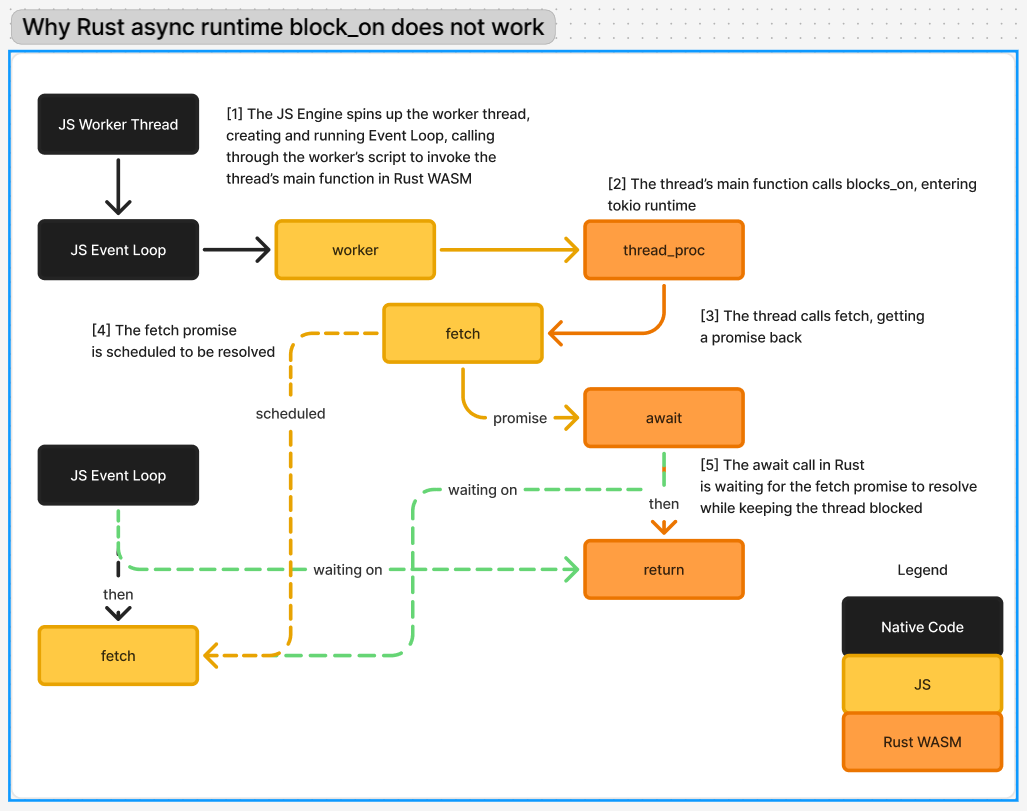
- The JS worker spins up and invokes the thread’s main function.
- The thread enters an async runtime within Rust.
- With the async runtime, the
fetchAPI in JS is called. - The
fetchAPI starts to do the network calls (implementation depends on the JS runtime/engine). - The
.awaitin Rust invokes theIntoFutureimplementation ofPromise, which is rather simple: it registers the waker of the future as theresolveandrejectcallbacks on thePromiseobject. When the promise is done, the waker notifies the runtime in Rust to poll the future again.
- Now comes the issue:
- For a promise to resolve, the control must be yielded back to the JS event loop. It cannot happen while the JS event loop is executing JS code. The JS event loop is in a context that invoked the thread’s main function, which must finish before it can do anything else that’s scheduled.
- However, the
block_onimplementation parks the thread until some future can be polled again (notified by the waker). It’s waiting for the JS event loop to resolve the future and wake up the async runtime in Rust.
- We have a dead lock!
So blocking on an async runtime does not work, but what if we use the js_sys::futures
runtime, which is backed by Promises and by design driven co-operatively with
the JS event loop?
#![allow(unused)]
fn main() {

#[wasm_bindgen]
extern "C" {
    fn fetch_text(url: &str) -> Promise;
}

let thread = wasm_bindgen_spawn::spawn(move || {
    // code here executes in a separate worker context
    // while sharing memory with other threads in the same process

    // Want async? Maybe use js_sys::futures?
    js_sys::futures::spawn_local(async move {
        let js_string = fetch_text("https://github.com").await.unwrap();
        let rs_string: String = /* cast omitted */ js_string;
        // wait.. how do we return the result?
    });

    // when the thread is done, it's done for good - the JS
    // worker will be terminated
});
}
Well, this time, there’s no dead lock, but the future also does not execute at all. Let’s again trace the execution.
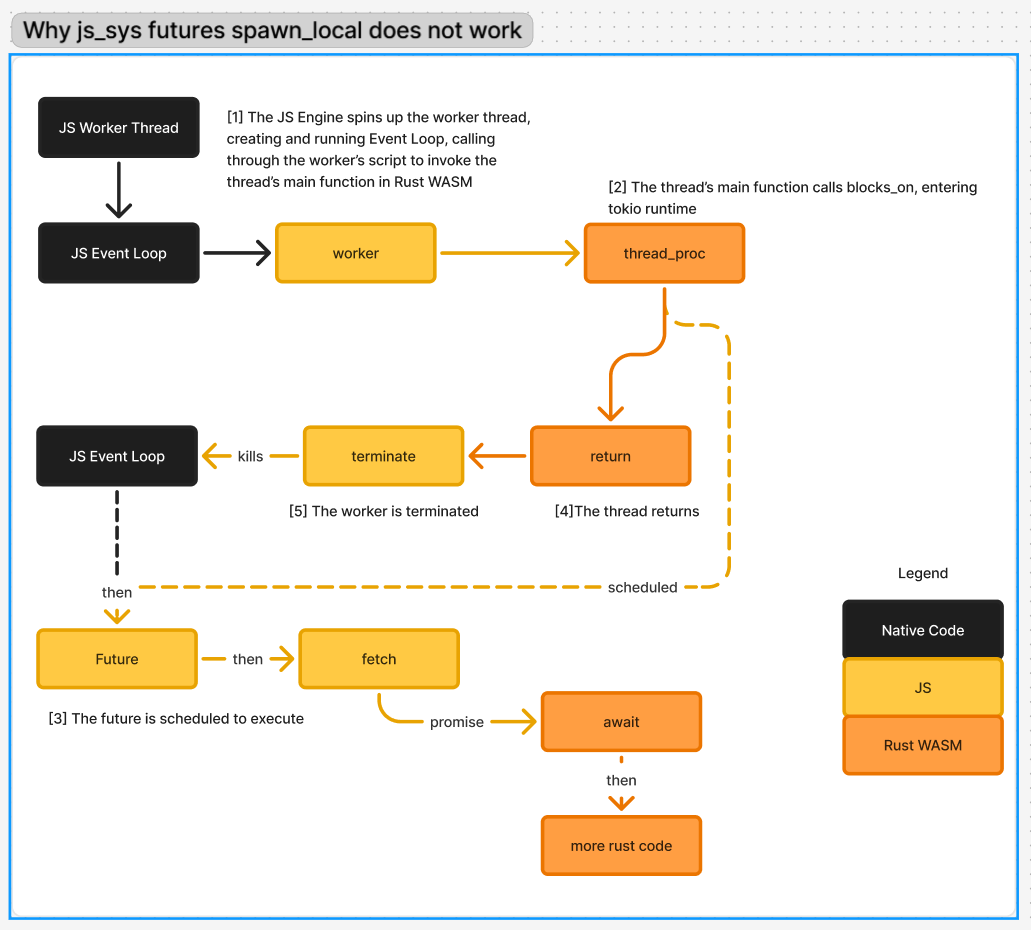
- The JS worker spins up and invokes the thread’s main function.
- The thread spawns a
JsFuture, which is backed by aPromise.- The implementation is as follows: The future will be
poll-ed in Rust with a waker. If it returnsPoll::Pending, the future must store the waker so it can notify the runtime to poll the future again when ready (this is just normal async Rust stuff, not JS-specific). In this runtime, when the waker is notified, it will then schedule to poll the future again after yielding to the JS event loop.
- The implementation is as follows: The future will be
- JS Promises are eager: the promise is immediately scheduled onto the JS event loop to execute.
- Then the thread’s main function finishes
- The worker is terminated
- Scheduled futures never get to run before the worker dies!
Now we see the full picture. The only way around this is to make the thread’s main function async
to allow the JS event loop to do other things if the main function needs to await.
Note
Q: Wait! But you said “terminate the worker” when the thread is finished. What if we just don’t terminate the worker when the thread’s main function returns?
A: Well, we still have to kill the thread when the main function finishes, otherwise the worker will just be left alive idling.
Q: Then we can register a callback so when the thread is finished, it can then terminate the worker…
A: Yes! And that’s exactly what we do!
invoke_thread_main().then(() => terminate_worker());
// is exactly the same as
await invoke_thread_main();
terminate_worker()
Send bounds
You may have noticed that the spawn_async API does not take an impl Future,
but an impl FnOnce() -> impl Future. This is because the thread’s main function
and the thread’s future need to satisfy different trait bounds for the Send
trait.
If the spawn_async API requires impl Future + Send, it will be basically unusable
for what it’s meant to be used with:
#![allow(unused)]
fn main() {
wasm_bindgen_spawn::spawn_async(async move {
    // hmm let's do something with JS
    let js_value = get_value_from_js();
    call_some_function_in_js(js_value).await;
    // BOOM!                           ^ future is not Send!
})
}
Recall that the Send trait is a marker trait for a type to be safe to send
across thread boundaries. Read more at Rust API Docs.
Now consider JsValue, a concrete example of a type that does not implement Send.
A JsValue is literally a reference to a value in the JS context. Obviously, you cannot reference the same value
in other JS contexts (i.e. other threads).
For a future to implement Send, it must be allowed to be sent to another thread
to continue execution (even in the middle of the execution, at await points).
But in our case, the future is only ever spawned locally on the thread’s JS event loop,
so it actually does not require Send. However, if we drop the Send requirement,
it will be even more disastrous:
#![allow(unused)]
fn main() {
// hmm let's do something with JS
let js_value = get_value_from_js();
wasm_bindgen_spawn::spawn_async(async move {
    call_some_function_in_js(js_value).await;
    // BOOM!                   ^ this is a reference that doesn't exist in this thread
})
}
As mentioned earlier, a JsValue is a reference to an object in the current
JS context. You cannot reference it in another JS context. So it’s not safe
to drop the Send requirement completely.
Therefore, we resort to
impl (FnOnce() -> impl Future) + Send
This means:
- The thread’s main function needs to be
Send - It will return a future to continue to do async work locally in the spawned thread.
This async work does not need to be
Send. - But if the future captures anything from the spawning thread, it also requires
the
Sendclosure to capture it, which requires that all captured variables beSend.